
Does choosing a registered ndis provider have to mean trading a personal connection for a checklist of compliance? It is a question many Australians face when they feel stuck between wanting the safety of a regulated service and the warmth of a support worker who actually knows their name. You might feel like you're just another file in a large, clinical system where the faces change every week and the NDIS jargon feels like a foreign language. It is frustrating when the very system meant to empower you ends up making you feel small.
We believe you shouldn't have to choose between professional standards and genuine human care. This guide is designed to help you cut through the complexity of the 2026 NDIS changes to find a provider that offers safety, consistency, and truly person-centred support. We will show you how to maximise the value of your plan while ensuring your support workers are reliable and aligned with your life goals. From understanding the new pricing schedules to identifying the traits of a quality boutique provider, you're about to learn how to turn your NDIS plan into a tool for a better, more connected life.
Key Takeaways
- Understand why a registered ndis provider must meet rigorous quality and safety standards overseen by the NDIS Commission.
- Learn how choosing a registered partner ensures access to all funding types, offering more flexibility for your specific NDIS plan.
- Discover how to look beyond the registration badge to find a team that prioritises worker consistency and familiar faces.
- Identify the signs of truly person-centred care that is built around your unique life goals rather than a standard template.
- Explore why a boutique, support-worker led approach can offer a more personal and culturally responsive experience.
What is a Registered NDIS Provider in 2026?
A registered ndis provider is an individual or organisation that has chosen to undergo a rigorous certification process to meet strict government quality and safety standards. In the context of the National Disability Insurance Scheme (NDIS), being registered means more than just having a certificate on the wall. It represents a deep, ongoing commitment to providing care that is safe, transparent, and legally compliant. It's about ensuring that the people who support you are held to the highest possible standard of professional conduct.
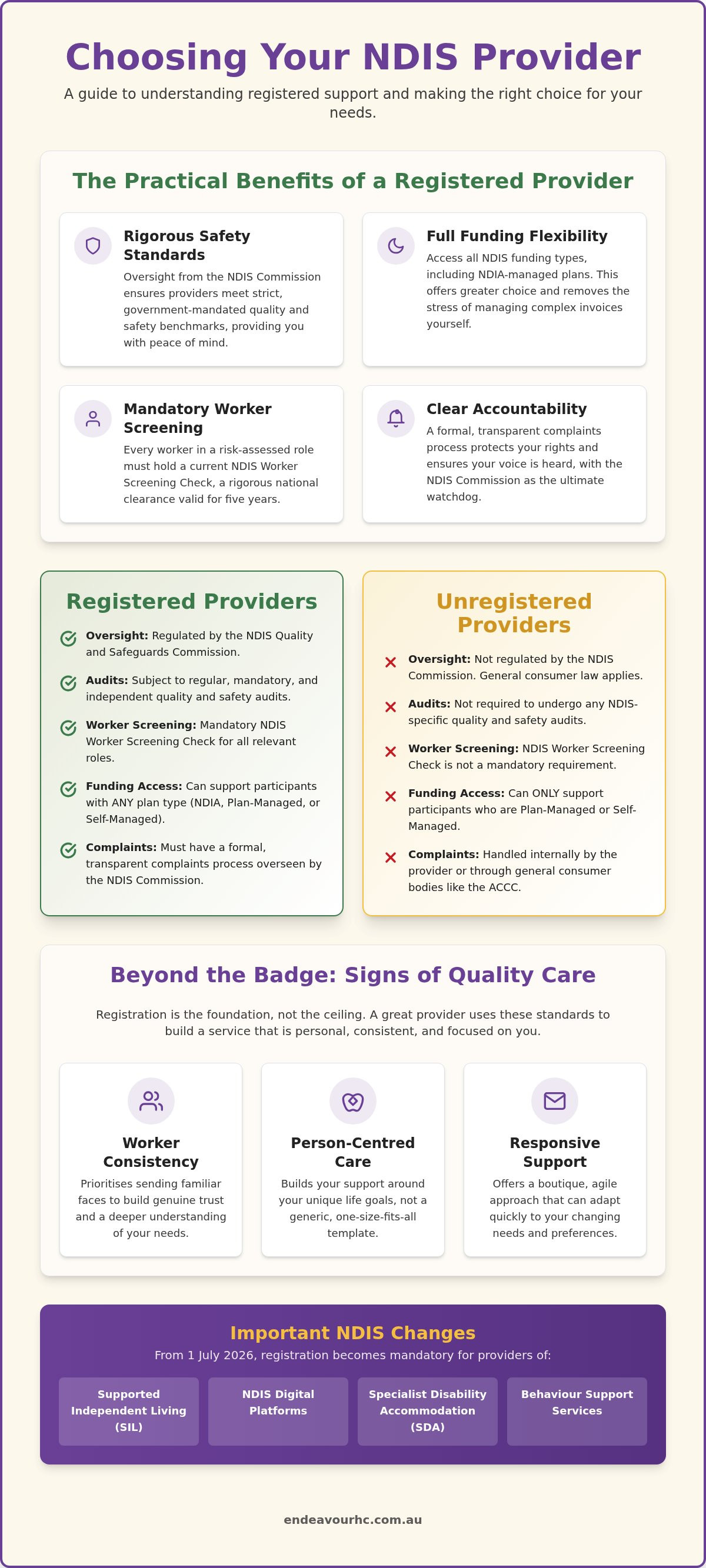
From 1 July 2026, the rules around registration have become even more defined to protect participants. Mandatory registration now extends to include:
- All Supported Independent Living (SIL) providers
- NDIS digital platform providers
- Specialist Disability Accommodation (SDA) providers
- Providers of behaviour support services
Registration isn't a one-off badge or a simple tick-box exercise. It's a continuous cycle of external audits and mandatory worker screening renewals. This ensures that every registered ndis provider remains financially accountable and operationally sound, providing peace of mind for families who worry about the stability of their support system.
The NDIS Quality and Safeguards Commission Role
The NDIS Quality and Safeguards Commission acts as the national watchdog for disability safety. Their primary purpose is to regulate providers, handle complaints, and protect the rights of every participant. By enforcing a strict NDIS Code of Conduct, the Commission ensures that every interaction between a provider and a participant is grounded in respect and safety. This oversight means that if things don't go as planned, there's a clear, powerful body ready to step in and hold providers accountable for their actions.
Registration vs. Compliance: Why it Matters for You
It's easy to see registration as just another layer of paperwork. However, for you and your family, it acts as a vital safety net. Compliance ensures that your provider isn't just "doing the paperwork" but is actually delivering a genuine quality of care. While a large system can sometimes feel clinical, a quality provider uses these regulations as a foundation for better care, not a substitute for it. It ensures that every worker entering your home has been screened and that the organisation is answerable to you. This accountability transforms the NDIS from a complex bureaucracy into a reliable support system that prioritises your dignity and well-being.
The Practical Benefits of Choosing a Registered Provider
Choosing a registered ndis provider often feels like a decision about paperwork, but it is actually about your peace of mind. For many families, the greatest benefit isn't the administrative compliance. It is the knowledge that there's a safety net under every support hour. Being registered means the provider can work with any participant, including those whose plans are managed directly by the NDIA. This gives you total flexibility. It opens up the full range of your funding without the stress of managing complex invoices yourself. You get to focus on your life while the provider handles the heavy lifting of compliance.
Safety Standards and Worker Screening
Safety isn't a "set and forget" task. In 2026, every worker in a risk-assessed role must hold a current NDIS Worker Screening Check. This national clearance is valid for five years and involves a rigorous assessment of a person's history across all Australian states. It is a high bar. We believe this vetting process is essential for building trust. When a provider is registered, they are also subject to regular audits by the NDIS Quality and Safeguards Commission. These audits ensure that emergency management plans and incident reporting standards never slip. It means your safety is monitored by experts. It is not just left to chance. If an incident occurs, there are clear, mandatory steps for reporting and resolution. This structure ensures that lessons are learned and safety is constantly improved.
Accountability and the Complaints Process
What happens when things don't go as planned? This is where registration proves its worth. A registered ndis provider must have a formal, transparent complaints process. You have a legal right to be heard. This system protects your rights and ensures that your feedback actually leads to change. It is about giving you a voice in how your services are designed. You aren't just a number; you're a partner. High standards also require providers to offer culturally responsive support. This means your heritage and personal values are respected as part of your daily care. It is about dignity. It is about ensuring your support workers understand what makes you, you. If you are looking for a team that treats these standards as a starting point for genuine care, you might want to explore our approach to boutique support. We believe that safety and warmth can go hand in hand.
Registered vs. Unregistered Providers: A Side-by-Side Comparison
Choosing between a registered and unregistered provider is one of the most significant decisions you'll make for your NDIS plan. It's about more than just a label on a website. It determines who can access your funding and what level of protection you have in your own home. A registered ndis provider must meet specific benchmarks that unregistered workers simply aren't required to follow. This choice impacts everything from your personal safety to how much you pay for support each week.
Management Types and Provider Choice
The way your plan is managed dictates your options. If your plan is Agency-managed, you're restricted to using registered providers. This is a deliberate safety measure by the NDIA to ensure oversight. If you're self-managed or plan-managed, you have the freedom to hire unregistered workers or private contractors. While this sounds like it offers more "choice and control," it places a heavy administrative burden on your shoulders. You must personally verify their insurance, their screening checks, and their quality of work. Understanding What is an NDIS Provider helps you see that registration is designed to remove this burden from you. A quality ndis service provider helps bridge the gap between compliance and choice. They offer the professional structure of a registered entity while maintaining the personal touch you'd expect from an independent worker.
Pricing and Value for Money
Registered providers must strictly adhere to the NDIS Pricing Schedule, which protects your budget from unexpected costs. As of 1 July 2026, the maximum price for standard weekday daytime support is $73.58 per hour. This cap ensures you aren't overcharged, allowing your funding to last for the duration of your plan. While some unregistered workers might offer a lower hourly rate, this often comes at a hidden cost. They may lack public liability insurance or professional indemnity cover. If an accident happens, you could be left vulnerable. True value is found in outcomes, not just the lowest price. A registered ndis provider invests in worker training and consistent matching. This means you spend less time training new faces and more time working toward your goals. It's about making every dollar in your plan work harder for your future.
How to Evaluate Your Support Options Beyond the Registration Badge
A registration badge is a starting point, not the finish line. Every registered ndis provider meets the same legal minimums, but the daily experience of their support can vary wildly. You deserve more than just a compliant service. You deserve a partner who sees you as a person, not a line item in a budget. Evaluating a provider requires looking past the certificates and into the heart of how they operate. It is about finding a team that speaks your language rather than hiding behind NDIS jargon.
Consistency is the most vital factor for your long-term success. If you're constantly explaining your routine or your goals to new faces, you aren't building independence; you're just managing a roster. Ask potential providers about their staff turnover rates and how they handle worker matching. A provider led by people with actual on-the-ground support experience often understands this better than a large corporation. They know that a good match is based on shared interests and personality, not just who is available for a shift. This personal touch is what transforms basic assistance into genuine care.
Questions to Ask Potential Providers
Before signing a service agreement, have a real conversation with the people who will be managing your support. Use these questions to gauge their commitment to your unique life goals:
- How do you match support workers to my specific personality, interests, and culture?
- What happens if my regular worker is unwell? Do you have a backup who has already met me and knows my routine?
- Can you show me practical examples of how you've helped others build independence at home or in the community?
Red Flags to Watch Out For
Trust your instincts during the initial meeting. If a provider tries to start services without taking the time to meet you face-to-face, they're likely focused on filling shifts rather than building a relationship. Other warning signs include:
- High staff turnover or "faceless" communication that always comes from a call centre or a generic email.
- Vague answers about how they track your progress or a lack of transparency regarding their service agreements.
- A "one size fits all" approach that feels like a template rather than a plan built around you.
You shouldn't have to feel like just another number in a large, impersonal system. If you want a team that prioritises your dignity and matches you with workers who truly care, contact our local, support-worker led team today to see how we can support your journey toward independence.
Why Endeavour Healthcare Offers a Different Kind of Registered Support
Choosing a registered ndis provider often feels like a choice between safety and soul. Many people worry that by opting for a regulated organisation, they'll be traded off to a large, faceless system where the support workers change every week. At Endeavour Healthcare, we believe you deserve both the highest safety standards and the warmth of a consistent, local team. Our founder, Manu, started this organisation with a simple mission: to lead a support-worker led team that puts the person before the paperwork. We've seen how the "rotating roster" problem in large agencies can make you feel like a stranger in your own home. We're here to change that.
Our approach is built on the belief that the best support comes from people who actually know you. We don't just fill shifts; we build relationships. This means you can count on seeing familiar faces who understand your routine, your communication style, and your specific goals. Whether we are assisting with personal care, daily living tasks, or providing reliable transport to your appointments, our focus remains on making the experience feel human. We treat the NDIS Practice Standards as a foundation for excellence, allowing us to provide safe, culturally responsive care that never loses its personal touch.
A Boutique Approach to NDIS Care
Being a boutique provider allows us to listen in a way that larger corporations often can't. We take the time to understand both your physical requirements and your psychosocial needs. Your life isn't a template, so your care shouldn't be either. We organise our services around your real-life goals, such as increasing your community access or building independence at home. Because our team understands the NDIS landscape from the ground up, we can help you navigate your plan's value without the clinical distance found elsewhere. You remain the centre of every decision we make together. This ensures your support is always aligned with the life you want to lead.
Getting Started with Person-Centred Support
Making the switch to a provider that values your independence is a straightforward process. We work directly with you and your support coordinator to ensure your NDIS plan is implemented with care and precision. We begin by sitting down with you to discuss your personality and interests, ensuring we match you with a support worker who is a genuine fit for your life. There are no complex hurdles or impersonal call centres; just a small, dedicated team ready to help you thrive. If you're ready for support that prioritises consistency and familiar faces, we invite you to take the next step. Contact Endeavour Healthcare to discuss your NDIS goals today and see how a local, registered ndis provider can make a real difference in your daily life.
Take Control of Your NDIS Journey
You now have the tools to look beyond the registration badge and find a partner who truly values your independence. Choosing a registered ndis provider shouldn't mean sacrificing the human connection that makes support meaningful. It is about finding the balance between the rigorous safety standards required by the Commission and the warmth of a team that actually knows your name. Your NDIS plan belongs to you; you have every right to demand consistency and care that fits your life rather than a corporate template.
At Endeavour Healthcare, we're a support-worker led team founded on the belief that everyone deserves person-centred care without the clinical distance. We're committed to matching you with familiar faces who understand your goals and respect your dignity every single day. Discover how our registered support team can help you reach your goals. You don't have to navigate this system alone. We're here to provide the steady, reliable support you deserve as you build the future you want.
Frequently Asked Questions
Can I use an unregistered provider if my NDIS plan is Agency-managed?
No, you cannot use an unregistered provider if your plan is Agency-managed. The NDIA requires all Agency-managed participants to work with a registered ndis provider to ensure high levels of oversight and safety. If you wish to use unregistered workers, you would need to change your management type to self-managed or plan-managed during a plan review. This restriction helps the NDIA monitor quality and financial accountability across the scheme.
What are the mandatory NDIS Practice Standards for registered providers in 2026?
In 2026, every registered provider must meet the NDIS Practice Standards, which include the Core Module covering participant rights, provider governance, and the safe delivery of supports. Depending on the services offered, they may also need to meet supplementary modules for things like behaviour support or specialist disability accommodation. These standards require regular external audits to prove that the organisation is actually following through on its promises of quality, safety, and personal dignity.
Does a registered provider cost more than an unregistered one?
Not necessarily. A registered ndis provider must adhere to the price limits set in the NDIS Pricing Schedule, which means they cannot charge more than the maximum hourly rate, such as $73.58 for standard weekday support. While some unregistered workers might offer lower rates, they often lack the insurance and auditing backing that a registered entity provides. Choosing a registered option ensures your budget is protected while maintaining professional standards of care.
How do I check if a provider's NDIS registration is still current?
You can verify a provider's status by searching the NDIS Quality and Safeguards Commission's Provider Register online. This public database lists all currently registered organisations and individuals, along with any conditions or enforcement actions against them. It is a good habit to check this register before signing a service agreement. You can also ask the provider directly for their registration number and evidence of their most recent audit to ensure they are compliant.
What should I do if I'm unhappy with the service from my registered provider?
You should first raise your concerns directly with the provider through their formal internal complaints process. Every registered entity is legally required to have a transparent way for you to voice your feedback. If you don't feel heard or the issue isn't resolved, you can contact the NDIS Quality and Safeguards Commission. They act as an independent body to investigate complaints and ensure your rights as a participant are being upheld by your registered ndis provider.
Why is worker consistency so important in disability support?
Consistency is the foundation of effective support because it builds trust and allows for a deep understanding of your routine. When you have familiar faces, you don't waste time retraining new staff on your goals or personal preferences. This stability is especially important for psychosocial support and complex care needs. It prevents the common problem where participants feel like a number rather than a person with unique life aspirations and cultural values.
Can a registered provider help with NDIS plan management and coordination?
Yes, many providers offer specific support to help you navigate your funding. While some organisations focus only on direct care, others provide plan management coordination to help you track your budget and service requirements. At Endeavour Healthcare, we work closely with your support coordinator to build a plan that reflects your real life. This collaborative approach ensures your funding is used effectively to achieve the independence and community access you are aiming for.
Is worker screening the same as a standard Police Check?
No, the NDIS Worker Screening Check is much more comprehensive than a standard National Police Check. It is a national clearance that involves an ongoing assessment of a worker's history, including police records and disciplinary findings across all states. While a police check is a point-in-time document, the NDIS screening is monitored continuously. This ensures that any new risks are identified immediately, providing a higher level of safety for everyone involved in the support process.


